
Clean label has moved from a niche preference to a mainstream one. Shoppers read the ingredient list, and a short list without preservatives has become a reason to choose one product over another. For food producers, that shift changes what the packaging line has to do.
Something has to take over what was removed. When preservatives, antioxidants and artificial colours and flavours come out of the recipe, the food has less protection of its own, and the job of keeping it fresh moves to the pack and to the equipment that fills and seals it.
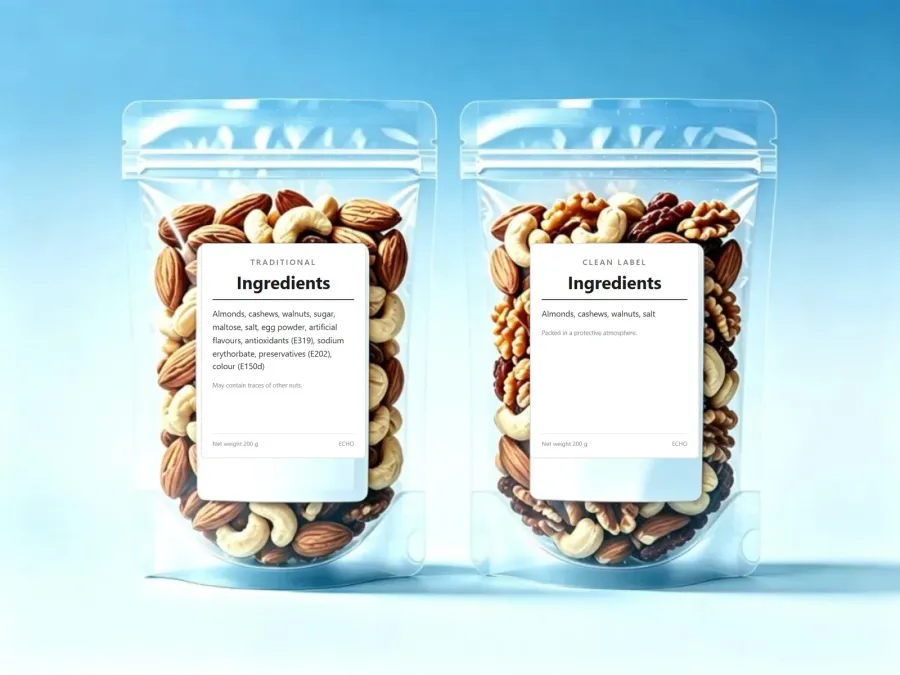
What clean label packaging has to do
For nuts, dried meat, biscuits and puffed snacks, the pack is the preservation system. It has to do three things at the same time.
- Keep oxygen out. Nuts and dried meat oxidise easily, and a small reduction in residual oxygen can add weeks to the shelf life.
- Keep moisture stable. Biscuits and puffed snacks need a steady water activity; if the barrier is not good enough, they go soft within weeks.
- Keep the flavour in. Gas flushing and seal integrity decide whether the product still tastes right at the end of the shelf life.
A better film on its own does not solve this. A sealing temperature that drifts by 2°C can pull the nitrogen replacement rate from 99% down to 95%. Uneven sealing pressure leaves micro leaks that open further under transport vibration. The shopper finds out at home, when the pack is opened.
Nitrogen flushing and modified atmosphere packing
Nitrogen flushing and modified atmosphere packing (MAP) are the usual replacements for chemical preservation. In a nitrogen-flushed pack the air is pushed out before sealing and replaced with gas, so the product is protected by the atmosphere inside the pack rather than by additives.
Three parameters decide whether the pack works: gas purity, replacement rate and seal integrity. If one of them is off, the other two cannot compensate.
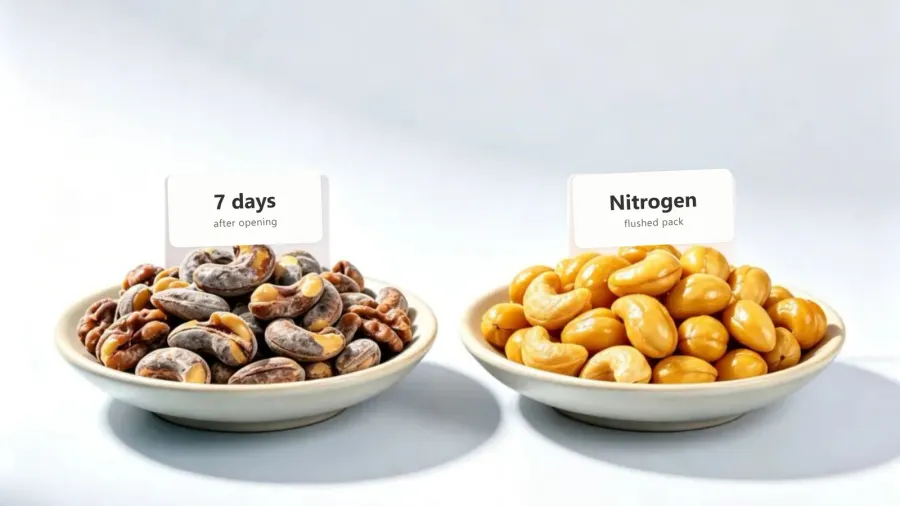
The pack also has to carry the claim
Clean label is not only about the ingredient list. Brands have to show “no additives” on the pack, and at the same time meet lightweight, recyclable and minimal packaging requirements.
One way to do both is to move information from the printed surface into the packaging process:
- High-barrier film instead of multi-layer laminates. The pack still protects the product, and it is easier to sort for recycling.
- Precise gas flushing instead of chemical preservation. The “no additives” claim then has a technical basis.
- Smart labelling instead of large printed areas. More information fits in less space.
All three depend on the machine. The pack is no longer just a container. It is part of how the brand keeps its promise.
Short shelf life leaves no room for error
Clean-label products often have a shorter shelf life. Many shoppers read that as fresh. In production it is a hard constraint, because every step from the factory to the shelf has to be right.
A small packaging defect that a long-life product can absorb becomes a quality incident in a short-life product. That sets the process window: sealing temperature within ±1°C, nitrogen replacement above 99%, and micro leaks down to ppm level.
Machines for clean label packaging
As ingredient lists get shorter, the precision and flexibility asked of packaging equipment gets higher. When preservation no longer comes from additives, the machine becomes the first line of defence.
Echo Machinery builds the machine types a clean-label line needs:
- Premade pouch packaging machines for stand-up, flat bottom and quad seal pouches.
- Vacuum packaging machines and vacuum flatten machines for products that need the air removed rather than replaced.
- Automatic tray sealing machines for MAP trays.
- Vertical form fill seal machines for rollstock film.
A clean-label project starts from the product: what it is, how sensitive it is to oxygen and moisture, which pack format the brand wants, and what shelf life the retail channel asks for. The machine specification follows from those answers, together with the sealing parameters, gas system and leak testing that keep the line stable from the first pack to the last.
If you are moving a product to a clean label, or running a short-shelf-life line and seeing more leakers than you would like, send us the product and the pack. We will tell you which machine and which sealing process fit.